|
The Arsenals
The
top three Russian arsenals are best described by Karl-Heinz Wrobel in
his article. I would like to thank him for his generous contribution to
this site.
| Weapons Manufacturing in
Russia |
(The
Early Years)
by Karl-Heinz Wrobel
Russia had a ordered,
organized tradition of weapons manufacturing that functioned relatively
well for an agrarian state. It consisted of a multiplicity of typically
smaller manufacturers, however only three larger arsenals would be used
for the production of the three-line rifle. At the top of each
manufacturer was a director, usually a high ranking artillery staff
officer, who led the operations and dealt with technical questions and
was assisted by a Associate Director who supported the administrative
tasks. There was also an adviser under the line of a staff officer for
the regulation of fundamental technical questions. Independent of the
actual operation, a control and a supervision commission, consisting of
several staff and subordinate officers, operated with the multiplicity
of barrel fabricators and master armorers.
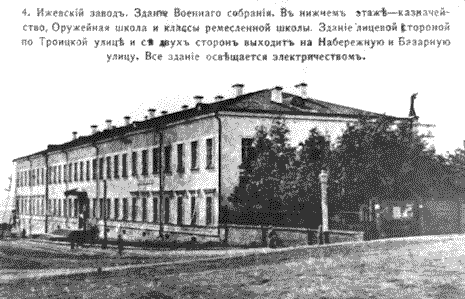
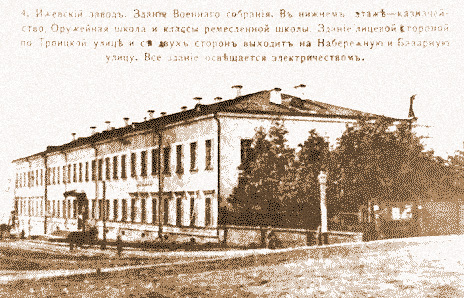
The
Kommandantur of the Arsenal in Ishevsk with attached school in the year
1880
Each Armory was a city within
itself. It contained schools, military hospitals, convalescent homes,
purchase organizations and advanced training facilities. Here the next
generation workforce was trained during four years of training courses.
Tula ( Tuljskaja Gubernija)
was at the time of the introduction of the rifle Mosin Nagant in 1891 a
District or Province of European Russia. Previously, Tula belonged to
the District of Moscow until 1777 . The District was about 200 km south
of Moscow, and covered roughly 31,000 square kilometers with
approximately 1.34 million inhabitants in 1882. The District was rich
in natural resources such as , iron, and was very suitable for cottage
industries. Tula, the capitol of the District was known to have areas
of strong ore deposits situated quite near to it.
The first weapons factory in
Tula , was established in1632 by the Dutchman Franz Marcellus. On 15
February 1712 by decree of the Czar Peter the Great, the Imperial
arsenal was establish as a donation by Prince Gregor Iwanowitsch
Wolkonskij. The first director of the new factory was Batistechev. In
the year 1817 it came under Katharina II and then under the guidance of
Alexander II. In 1874 a reorganization took place which resulted in the
designation "Imperial Armament Makers" in 1875. In 1882 production was
driven with 3,000 to 5,000 workers annually resulting in the
manufacture of between 75.000 and 160.000 Berdan rifles.
The city was a prime location
for rail access because of the river Upa and in 1882 had particularly
good rail connections, which resulted from the importance of the
resident arms industry. The number of inhabitants amounted to 63,510
persons at this time. The city had hosted an institute for cadets and
an arsenal. In the year 1896 armament makers with the aid of 1,400
machine tools could manufacture 913 weapons per day.
In the last years 19th
Century the factory was extended because of the pending production of
the three-line rifles and received approximately 1,400 new machines,
mostly from France. In addition to the different army rifles, the
Nagant pistol, other light arms and edged weapons, hunting rifles and
ammunition was manufactured there. The number of workers employed in
the manufacture of the three line rifle in the first three years of
production is illustrated by the following table:
|
Year
|
Total
Workforce
|
Year
|
Total
Workforce
|
|
1892
|
4.105
|
1896
|
8.937
|
|
1893
|
8.094
|
1897
|
8.142
|
| 1894 |
10.045 |
1898 |
8.328 |
|
1895
|
9.586
|
1899
|
7.035
|
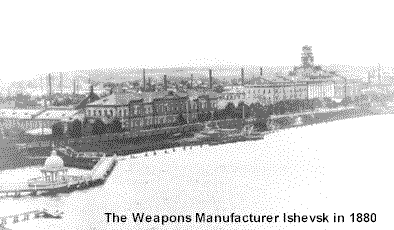
Ishevsk is a city in Russia
that lays 77 km northwest of Sarapul on the river Ischa in the
foothills of the Ural mountains. In 1760 the Russian Count Schuwalow
established an ironworks which manufactured mainly firearms and
cannons. Ishevsk is a city in Russia and lies 77 km northwest from
Sarapul. Due to the influence of access of the river Ischa in the Urals
, in 1760 were created there by the Russian count Schuwalow an iron
goods factory, which manufactured mainly firearms, primarily cannons.
In 1763 the factory was taken over by the Russian government and
produces weapons to this day. The actual establishment of the Weapons
Arsenal Ishevsk took place however on 10 July 1807. Due to the
strategic considerations of the world situation (a threatened invasion
of Russia by France under Napoleon) the Czarist government searched for
a location for a weapons manufacturing facility, that was not as
endangered as Tula and Sestroreysk and one that was close to the
natural materials required for weapons production. In 1804 Alexey
Fiodorovitch Deriabin was assigned this location search. He decided on
Ishevsk with its well equipped metalworks . Already in the year 1825
Ishevsk was the most modern and most efficient Russian operation for
weapons production. It received its energy source from the river (1,120
HP) as well as from steam engines (1,973 HP). Between 1807 and 1907
alone there approximately four million rifles built. One must realize
however the fact that the workers in Ishevsk were conscripted with a 25
year obligation and no possibility of quitting. Measured by today's
standards, the work at Ishevsk was simply slave labor.
1882 the city belonged to the
Russian Government of Wjatka and had 2,048 inhabitants. In 1902 3,637
workers were committed to the armament industry with approximately
7,000 in 1903 and 1905 exactly 6,366 workers committed to the
production of the new three line rifle. Starting from the year 1900 the
arsenal experienced an enormous upswing. It possessed the latest modern
special machines from France and Switzerland, altogether approximately
3,000 different machines, besides older English machines from the 70's
which added an additional 1,370 milling machines. For the production of
the three-line rifle an additional 675 new machines were ordered and
set up. In the year 1896 daily production was up to 1.000 three-line
rifles per day. This number dropped in the year 1899 to 600 rifles per
day. Ishevsk also manufactured the blanks and components of the Mosin
Nagant for the Sestroretsk and Tula arsenals to finish.
The factory became famous for
it's outstanding and very low-priced tool steel. In addition to army
rifles light arms and edged weapons and artillery ammunition for the
Russian army and the navy was produced. During the Russian civil war
the Ishevsk Armory occupied by the " White Army " in 1919 for several
months. In the Soviet Union, Ishevsk was capital of the usmurtish ASSR.
Up to today Ishevsk held different factories for the production of
military , sport and hunting weapons. The successor of the former
Ishevsk weapon manufacturer is today's Izhmash company.
|
Sestroretsk,
Sestroriatsk or Systerbäck
|
The specification concerning
this factory is generally very poor. The place Sestroretsk is regularly
on maps. If one looks it up in dictionaries whether older or new, there
does not emerge a description of the place or armament makers anywhere.
In the Russian literature the city Sestroretsk and the factory were
created as third armament makers in the year 1721 or 1724, at the same
time with the cannon foundry Alexandrowsk in Olonez for the Russian
navy. The non-Russian literature indicates that this factory would only
have been established because of the production of the three-line
rifles by the Imperial Russian government. However the same source
gives the production number in the weapons factory at time of Czar
Peter the Great, as busy with workers numbering 683. Anyhow Colonel
Mosin took over the leadership of the quantity production of the
infantry rifles M1891starting from 1894 . The production ran in
Sestroretsk until 1918.
The place Sestroretsk is approximately 27 km northwest from St.
Petersburg on height of Kronstadt close Oranienbaum on the Finnish sea
basin. The factory was established for the use of water power at the
river Sestra. Their first director was a Swede named Christian Petrol.
In the year 1780 the factory was almost completely destroyed by a fire
and could resume firearm production until the year 1799. In the year
1867 Sestroretsk was denationalized and only seventeen years later was
again put under state control. The number of the workers varied in the
years 1880 to 1894 between 2.500 and 2.600. For the building of the new
infantry rifles Sestroretsk received 206 additional machines. In the
year 1898 only 1,000 workers in the 8-hour day were there busy. In the
year 1903 the factory had 1.200 workers and 940 machine tools and could
manufacture approximately 30,000 three-line rifles annually.
Sestroretsk was the factory, where all the theories for the three-line
rifle were produced. That served to guarantee the exchangeability of
the weapon components for all rifles. Firing tests were conducted
beginning in the year 1895. Two rifles each out everyone of the four
factories (Tula, Ishevsk, Sestroretsk and Chatellerault) were
completely dismantled and assembled in such a way that from the parts
eight new rifles were made containing the same number of individual
parts from each factory. The weapons functioned perfectly. The
assembled rifles then were tested for rapid fire, on the average 22.8
shots per rifle and minute. There were no incidents of damage or
malfunctions noted.
Sestroretsk workers played a
larger role due to the proximity of the headquarters of Lenin in St.
Petersburg with the October Revolution. During the Russian civil war
the danger existed that the " White Army" troops might occupy the
factory. Therefore the machines were removed and the factory was
evacuated. Afterwards one converted the factory into a repair center.
When the German troops besieged Leningrad starting from 1941, the Finns
allied with the Germans and closed in on the factory, so that it had
again to be evacuated. The Sestroretsk workers were absorbed in the
Leningrad production plants, among them the " Red Toolworks ". With the
establishment of the modern Soviet production plants for hand-held
weapons, the factory at Sestroretsk lost it's importance. The factory
does not exist any longer.
|



