Global Mosin Nagants
The Mosin Nagant rifle gives
new meaning to imitation is the most
sincere form of flattery. Of course with
the Soviets, imitation was a product of
the doctrine of production for the
masses. This weapon was produced or
re-arsenaled in many different countries
during it many years of active service.
These countries ranged from
the Soviet satellites to the United
States. Most of the information
presented here has been well
documented but some has not. Part of
collecting is studying the history but
also the "lore" of a particular
weapon.
The Mosin Nagant was produced
in France, Hungary, Bulgaria, Poland,
Finland, China, Romania and the United
States. It was re-arsenaled in the
afore mentioned counties as well as in
Austria, Germany, The German
Democratic Republic, Cuba, Korea, and
Turkey. In terms of "production" v/s
"re-arsenaled", it's a fine line to
walk. In the main, most of these
countries fabricated their rifles from
Russian produced receivers. The
defining criteria for production rests
with the extent of the work performed.
In the case of Finland, the work was
indeed extensive in that they created
completely new configurations. In
other countries, it was merely a
process of adding new barrels or
domestically produced stocks. In
others, it was simply a matter of
their arsenals accepting,
reconditioning and proofing an
otherwise unaltered weapon. It's
hard to garner much hard documentation
on the subject as the former Soviet
Union kept arms production data as
well as distribution data highly
compartmentalized. As a result, for
every "fact" surrounding the origin of
the basic models, there exists some
"lore". I will attempt to point that
out when encountered in this section.
East
Germany


Austria-Hungary
Austro-Hungarian forces on
the Eastern Front captured sizeable
quantities of Russian rifles, and also
received large numbers taken by the
Germans. In 1916, guns in
Austro-Hungarian service were issued
with Russian ammunition. When supplies
began to run short, some guns were
converted in the Wiener-Neustadt
armory for the standard rimmed 8 x
50mm Austrian round. The original
Russian style socket bayonets were
retained wherever possible, but some
crude Austro-Hungarian substitutes
have been reported. After Hungary
became a satellite of the former
union, these weapons found their way
back into the inventory and the M/44
carbine was produced there after
W.W.II.
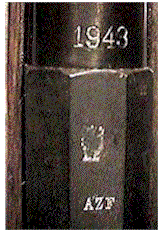
Austrian
Capture
Mark
China
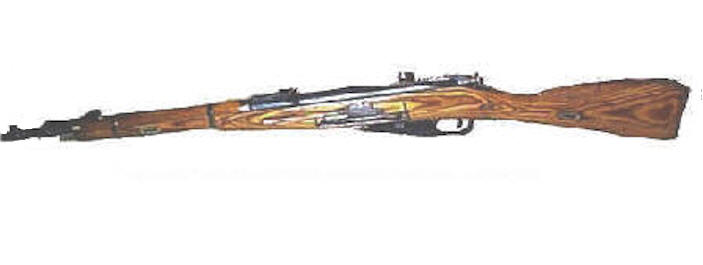
The Peoples Republic of China
made Mosin Nagant Type 53 carbines.
They are copied after the Soviet obr.
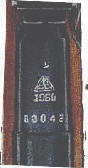
1944g. but were marked with "53" on
the receiver and were made by factory
26 for the interior security forces.
Photo
by
David Franchi
Production of the Type 53 was
discontinued in 1960. Some of these
weapons later surfaced in Viet Nam
during the 60's. Note: BATF does not
recognize this model as a
Curio&Relic eligible firearm.
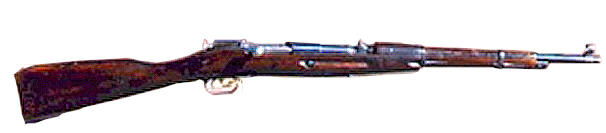
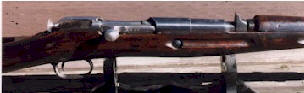
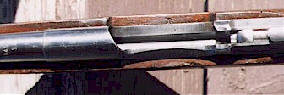 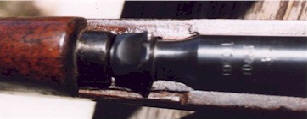
A Chinese 7.62x39 mm single
shot trainer. This rifle is very rare
and is one of three brought to the
states by an Arizona importer. They
were discovered in a shipment of Type
53's.
Czechoslovakia
M91/38
Carbine

Odstrelovaci pujka vz.54
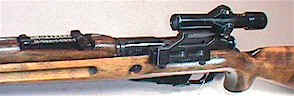
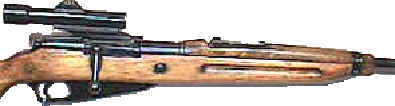
Built on specially finished,
but otherwise standard obr.1891/30
actions, this sniper rifle was
developed to share a special 7.62mm
ball cartridge being made for the
Goryunov machine-gun. It had a
pistol-grip half stock and a hand
guard running forward from the
receiver ring. There was a single band
at the tip of the fore-end and a
grasping groove beneath the back
sight. Owing to the free-floating
barrel, the vz.54 was accurate and
dependable. However, it was never made
in large numbers.
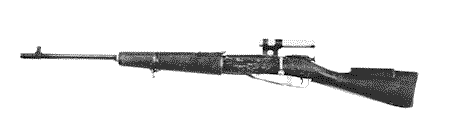
ZG 51/91/30
After the revolution of 1948,
Czechoslovakia continued to produce
Mauser-type rifles. A modified sniper
rifle (ZG 49 Sn), submitted to trial
by Otakar Galas in the late 1940s, was
developed into the ZG 51 Sn , but a
change of heart--perhaps influenced by
the Soviet Union--led to the
development of the similar ZG 51/91/30
on the Mosin-Nagant action.
Hungary



Hungarian
M/44 - Photo by Jean from Tuco's
Substantial quantities of
Mosin Nagant guns were made by FEG of
Budapest in the early 1950's.
Production centered around well made
copies of the obr.1944g. carbine and
the obr. 91/30 sniper rifle.
France
Rare Chatterault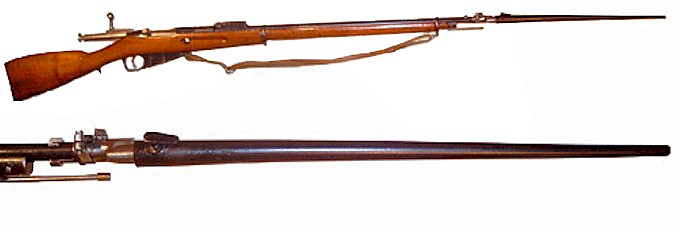
K-H Wrobel Collection

The very first Mosin rifles
were produced not in Russia but under
contract in France. Russia's
industrial capacity was over-taxed
during the development of the M91
rifle and political circumstances
forced them to turn to the only
country they had a treaty with that
could produce the rifle for them.
France agreed to produce the rifle
under contract with production
beginning in 1892 and ending in 1895.
Korea
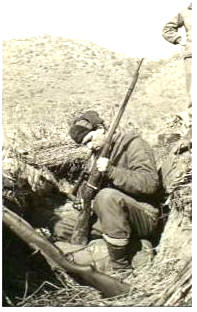
A poor quality copy of the
Mosin Nagant M/91-30 was produced in
the 1950's. Labeled the Type 30, it
was distinguished by the large
encircled five-pointed star just
before the serial number on the
receiver.
Poland
The earliest Polish Mosin
Nagant was in the 1920's and was a
converted Russian rifle with a new
7.9mm barrel. It featured a magazine
altered to feed rimless cartridges. It
was designated the wz.91/98/25 and had
a German-style nose cap and bayonet
bar. The sling swivels were on the
side of the barrel band and left side
of the butt. The gun was about 1,100mm
long and had a 600mm barrel. It
weighed somewhere around 3.7 kg
unloaded.
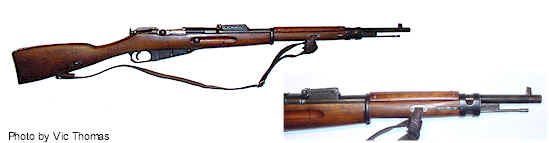
The most notorious Polish
manufacture is that of the M/44
carbines and the lesser known copy of
the M/91-30 sniper rifle. There
were also military trainers in .22
cal. produced by the state arsenal
Radom.


Photo by
willyp
Romania
Romania produced a large
number of M/44's possibly for home
defense but it is believed that their
eye was on the third world export
market.
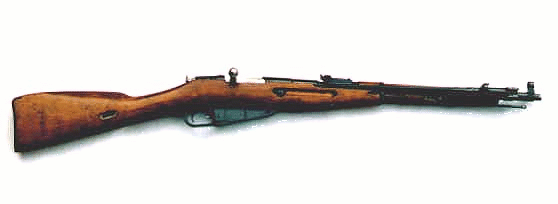
Photo by David
Franchi
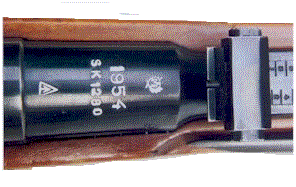
A 91/30 pattern rifle has
emerged in the latest batch of imports
. They feature a Romanian Laurel PRP
Crest and proofs on the barrel shank--
markings as seen on Romanian M44's,
blade front sight, and on one reported
example, a windage adjustable rear
sight.

USA
The US government has
purchased more than a million M/8191
rifles from Remington-UMC and
Westinghouse after the Russian
revolution. Both companies had large
contracts with the former Russian
Imperial government to produce the
Mosin Nagant. Only 280,00 of these
rifles were retained by the U.S. Army
and they were for the most part only
used for basic training purposes.
Oddly enough, many of the US acquired
Mosins eventually found their way to
Russia when the U.S. sent troops to
Archangelsk in 1919. The weapons
were so disliked by U.S. soldiers that
they were mostly abandoned in Russia
when they left in 1920. Many of the
Mosin Nagants purchased by the U.S.
government ended up with National
Guard units and sold as surplus and
eventually "sporterized" and sold on
the open market. One of the
conversions was done by Bannerman in
30-06 and is considered by many to be
extremely dangerous to fire.

|



